
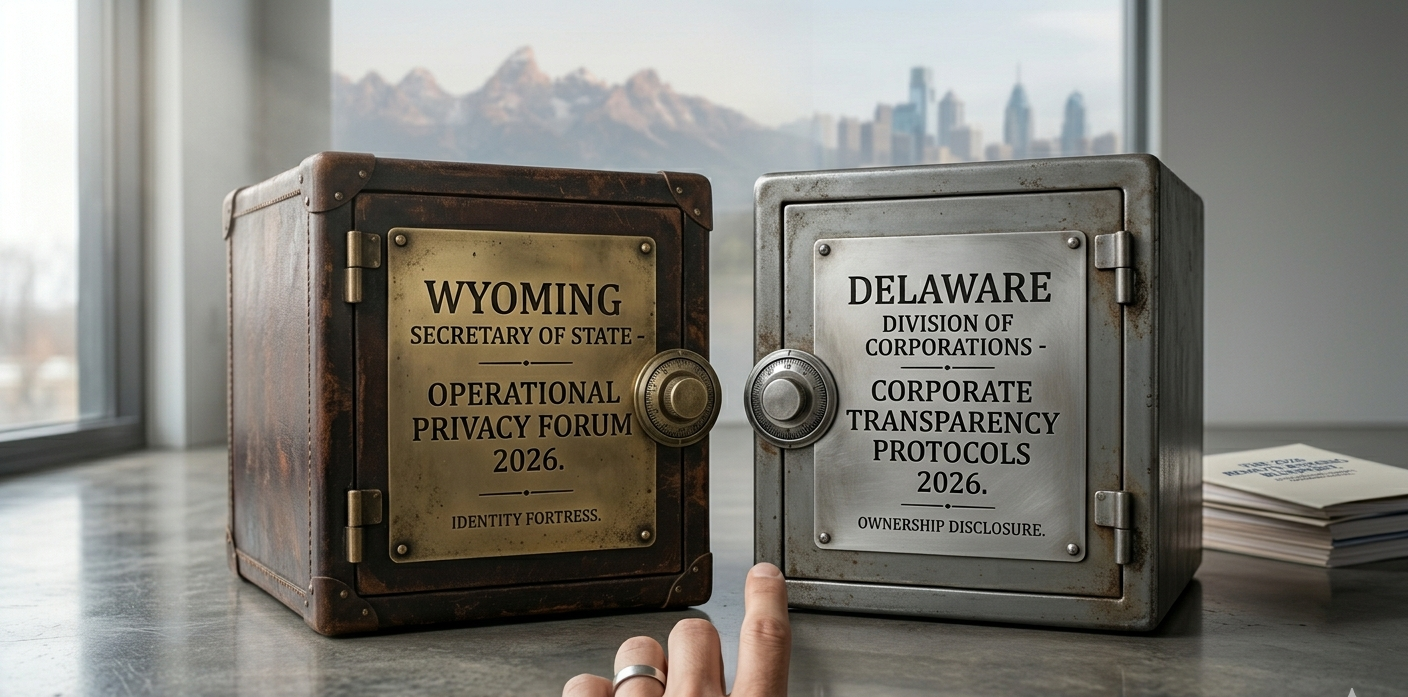

A practical guide for entrepreneurs, founders, and privacy-conscious LLC owners
I. Why Your State of Formation Matters for Privacy
Most entrepreneurs pick Delaware on autopilot — it’s where lawyers point you, where investors expect you, and where Silicon Valley legends say you belong. But in 2026, that default deserves a serious challenge. New federal reporting requirements, sophisticated data broker operations, and a growing wave of privacy-conscious founders have put Wyoming firmly on the map as a genuine alternative. This article cuts through the noise and gives you a direct, up-to-date comparison so you can make an informed choice based on what actually matters for your situation.
II. The Privacy Landscape in 2026
To understand why the Wyoming vs. Delaware debate matters more than ever, you first need to understand what the privacy landscape looks like for LLC owners today. The rules of the game have changed significantly, and the state-level protections that once made certain jurisdictions attractive have been partially — though not entirely — superseded by federal law.
The Corporate Transparency Act (CTA), which took effect in 2024, requires most US LLCs and corporations to file Beneficial Ownership Information (BOI) reports with the Financial Crimes Enforcement Network (FinCEN), a bureau of the US Treasury. These reports identify the real individuals behind a company — those who own 25% or more of the entity, or who exercise substantial control over it. In 2026, this requirement applies to the vast majority of small LLCs. The critical point: BOI reports are filed with the federal government, not made publicly available. Only authorized government agencies can access them under specific circumstances.
This means that forming an LLC in Wyoming or Delaware does not exempt you from federal beneficial ownership disclosure. What state choice does affect is what appears in publicly accessible databases — the state’s own business registry, the documents filed at formation, and the public records that data brokers scrape and resell. For many founders, this distinction is the entire game. They are not trying to hide from the government; they are trying to prevent their home address and name from appearing on the first page of a Google search, in the hands of litigation attorneys, or in marketing lists sold by data aggregators.
The threat model for most entrepreneurs is not law enforcement — it’s public exposure. Real estate investors don’t want tenants or competitors knowing which properties they own. Online business owners don’t want critics or customers tracking them to a home address. High-profile individuals don’t want their business dealings tied to their personal identity in public databases. For all of these people, the public-facing layer of the state registry is what matters most.
Delaware’s business registry is among the most heavily indexed and scraped databases in the United States. Its Division of Corporations website is clean, searchable, and routinely harvested by data brokers. Wyoming’s equivalent is far less prominent in the data ecosystem, which provides practical — if not legal — obscurity. Beyond the registry itself, the two states differ significantly in what information they actually require you to disclose at formation, and that is where the structural differences begin to matter.
Understanding this context is essential before diving into the comparison. Neither state makes you invisible. Both states now operate within a federal framework that requires some level of disclosure. But within those constraints, the choices you make at the state level can meaningfully affect how much of your personal information ends up in publicly accessible records — and how easily it can be found.
III. Wyoming: The Privacy-First State
Wyoming has quietly built one of the most privacy-protective business formation environments in the United States. It did not happen by accident. The state has deliberately positioned itself as a haven for entrepreneurs who value confidentiality, asset protection, and low-cost operations — and the legal framework backs it up.
The most important structural feature is what Wyoming does not require. When you form an LLC in Wyoming, you are not required to disclose the names of members or managers in your Articles of Organization, which is the publicly filed formation document. The registered agent’s name and address serve as the public-facing contact for the entity. This means that a properly structured Wyoming LLC, using a professional registered agent service, will not have your personal name in any publicly accessible state filing. A data broker scraping the Wyoming Secretary of State’s website will find the LLC name, the registered agent, and the formation date — nothing more.
Wyoming also has no state income tax and imposes no franchise tax on LLCs. The only recurring cost to maintain a Wyoming LLC in good standing is an annual report filing fee, which as of 2026 remains among the lowest in the country. For multi-asset investors and holding company structures, this low carrying cost makes Wyoming an attractive long-term home.
On the asset protection side, Wyoming offers some of the strongest charging order protections available under any US state law. A charging order is the remedy a creditor can pursue if they win a judgment against an LLC member personally. In most states, a charging order gives the creditor the right to receive any distributions the member would have received. Wyoming goes further by making the charging order the exclusive remedy — meaning a creditor cannot foreclose on the membership interest or force a liquidation of the LLC’s assets. This is a meaningful structural protection for anyone using an LLC to hold real estate, intellectual property, or investment accounts.
Wyoming also offers the Series LLC structure, which allows a single master LLC to contain multiple protected series, each with its own assets and liabilities. This is particularly popular among real estate investors who want to hold multiple properties under separate liability shields without the cost and administrative burden of forming a separate LLC for each one.
The drawbacks are real but manageable. Wyoming’s court system is a general-purpose state court — it does not have a dedicated business court the way Delaware does. Case law on complex LLC disputes is limited compared to states with longer commercial histories. If you anticipate sophisticated equity arrangements, investor disagreements, or complex governance disputes, the lack of dedicated business court precedent is a genuine limitation. Additionally, if your business operates primarily in another state, you will likely need to register as a foreign LLC in that state regardless of where you formed, which adds another layer of cost and administrative overhead. Wyoming’s privacy advantages do not travel automatically to your home state’s filings.
IV. Delaware: The Prestige State with Mixed Privacy
Delaware’s dominance in US business formation is not a myth or a legacy artifact — it is built on genuine, durable advantages that matter enormously for certain types of businesses. Understanding what Delaware actually offers, and where its privacy protections are stronger or weaker than commonly assumed, is essential for making an honest comparison.
First, a common misconception: Delaware LLCs also do not require member names in public formation documents. Like Wyoming, a Delaware LLC’s Certificate of Formation does not disclose who owns or manages the entity. This surprises many people who assume Delaware is more transparent than Wyoming simply because it is the default corporate state. For LLC structures specifically, the public privacy at the formation document level is comparable between the two states.
Where Delaware stands apart is in the quality and predictability of its legal infrastructure. The Court of Chancery is a specialized court that handles only business and equity matters, with no jury trials. It has been operating for over two centuries and has produced an extraordinarily deep body of case law on corporate governance, fiduciary duties, shareholder rights, and contractual disputes. When a complex business dispute arises, Delaware courts can resolve it with precision and speed that general-purpose courts in other states cannot match. For this reason, virtually every venture capital term sheet in the country specifies Delaware as the governing law and jurisdiction.
This investor preference is not trivial. If you plan to raise institutional capital — angel rounds, seed, Series A, and beyond — forming in Delaware is not just a preference, it is effectively a prerequisite. Most VC funds have legal constraints that limit or complicate investments in non-Delaware entities. Attempting to raise money as a Wyoming LLC will add friction, legal cost, and investor skepticism to your fundraise. For startups on a capital-raising path, Delaware is the only rational choice.
Delaware also has a well-developed ecosystem of registered agents, corporate attorneys, and formation services that makes administration straightforward. The state’s Division of Corporations is highly efficient and offers expedited processing options that are genuinely useful when you need to close a deal quickly.
The privacy drawbacks are worth understanding clearly. Delaware’s business database is extensively indexed — it is one of the most searched, scraped, and cross-referenced business registries in the country. While your name may not appear in your LLC’s Certificate of Formation, the sheer volume of data broker activity around Delaware entities means that any information associated with your entity is more likely to surface in a search. For C-corporations specifically, Delaware requires the names of officers and directors in the annual report, which is a public document. If you are operating as a C-corp rather than an LLC, your name will appear in publicly accessible state records.
The annual franchise tax for Delaware corporations can also add up significantly. Small corporations with relatively modest assets may face franchise tax bills of several thousand dollars per year under certain calculation methods, requiring careful planning to minimize. Delaware LLCs face a flat annual fee rather than a franchise tax, which is more predictable and typically lower.
V. Head-to-Head: Key Comparison Across Privacy Factors
With the individual profiles in place, it is useful to put the two states side by side across the factors that matter most for identity protection and business privacy.
| Factor | Wyoming | Delaware |
| Owner name in public filings | Not required | Not required (LLCs) |
| Registered agent address substitution | Yes — fully permitted | Yes — permitted |
| Annual franchise tax | None for LLCs | Corp: $400+ / LLC: $300 flat |
| State income tax | None | 8.7% corporate rate |
| Court system | General courts | Dedicated Court of Chancery |
| Data broker exposure | Low — minimal indexing | Higher — heavily indexed DB |
| Charging order protection | Strong (exclusive remedy) | Moderate |
| Investor / VC preference | Low | Very high |
| Series LLC available | Yes | Yes |
| Case law depth | Limited | Extensive (200+ years) |
| Federal BOI reporting (CTA) | Required | Required |
On the question of public name disclosure, the two states are more similar than most people realize. Neither requires LLC member or manager names in formation documents, and both permit the registered agent’s address to serve as the public contact for the entity. The practical privacy difference at the formation document level is minimal for LLCs.
The divergence becomes significant when you consider the data broker ecosystem surrounding each state’s registry. Delaware’s Division of Corporations database is aggressively scraped by commercial data brokers, people-search engines, and legal research platforms. Wyoming’s registry receives far less attention from these commercial data aggregators, which means that even identical structural privacy protections produce different real-world exposure levels depending on which state you choose.
On taxes, Wyoming is the clear winner for most small businesses and holding companies. No state income tax and no franchise tax for LLCs translates to meaningful annual savings over the life of an entity. Delaware’s fees are reasonable but not negligible, particularly for corporations that must navigate the franchise tax calculation carefully.
The Court of Chancery distinction matters primarily if you anticipate litigation or complex governance disputes. For a straightforward single-member LLC holding investment assets, this advantage is largely theoretical. For a multi-investor startup with complex equity arrangements, it is highly practical and often decisive.
On charging order protection, Wyoming’s exclusive remedy standard is meaningfully stronger than Delaware’s. This is a real asset protection advantage for businesses holding significant assets within the LLC structure, and it is one area where Wyoming has no serious peer among US states.
The federal BOI reporting requirement under the CTA applies equally in both states. Regardless of whether you form in Wyoming or Delaware, if your LLC is subject to the CTA — and most small LLCs are — you must file a BOI report with FinCEN identifying your beneficial owners. State-level privacy protections do not eliminate federal disclosure obligations, and any formation guide that suggests otherwise is giving you incomplete information.
VI. Use Cases: Which State Is Right for Your Situation?
The Wyoming vs. Delaware decision is not universal — it depends heavily on what kind of business you are building, who you are building it for, and what threats you are most concerned about protecting against.
Wyoming is the stronger choice for solo entrepreneurs and independent consultants who operate online businesses without plans to raise institutional capital. For this group, the combination of no state income tax, strong charging order protections, low annual fees, and minimal public data footprint makes Wyoming the most cost-effective and privacy-protective option available. A freelancer, course creator, or e-commerce operator forming a single-member LLC has virtually nothing to gain from Delaware’s legal infrastructure and much to lose from the increased data broker exposure that comes with it.
Real estate investors represent perhaps the clearest Wyoming use case. Holding individual properties or portfolios inside Wyoming LLCs provides a combination of liability protection, tax efficiency, and privacy that is hard to match. Wyoming’s Series LLC is particularly well-suited to investors who want to hold multiple properties in legally separate buckets without multiplying their formation and maintenance costs. The charging order protection is especially valuable for landlords, who face a higher-than-average risk of tenant litigation.
Privacy-conscious founders — those building businesses in sensitive industries, high-profile individuals, or entrepreneurs who have been the target of harassment or litigation — will generally find Wyoming’s lower public profile more valuable than Delaware’s legal sophistication. If your primary concern is preventing your name and home address from appearing in public records and data broker databases, Wyoming’s structural approach and smaller data footprint are meaningful advantages.
Delaware is the right choice for startups that intend to raise venture capital or institutional funding. This is not a close call. The VC ecosystem is built around Delaware, and attempting to fundraise as a non-Delaware entity introduces friction that is simply not worth the privacy benefit for most founders in this category. Delaware C-corps also offer the standard equity instruments — common stock, preferred stock, convertible notes, SAFEs — that investors expect, with the legal predictability to enforce them efficiently.
Businesses anticipating complex governance disputes, minority investor disagreements, or contested management decisions will also benefit from Delaware’s Court of Chancery. The availability of established case law and specialized judges who understand business disputes can make the difference between a fast, predictable resolution and years of expensive litigation in a general-purpose state court.
One increasingly popular strategy worth highlighting is the Wyoming-Delaware stack. In this structure, a Wyoming LLC serves as the parent holding company, owning the membership interests or shares of a Delaware C-corp that operates the business. The operating entity gets Delaware’s investor-grade legal infrastructure, while the holding company layer adds a privacy buffer and strong charging order protection. This approach is not without complexity — it adds administrative overhead and requires careful legal structuring — but for founders who want both privacy and capital-raising capability, it is worth exploring with a qualified business attorney.
VII. Practical Tips: Maximizing Your Privacy Regardless of State
State selection is only one lever in the privacy equation. The choices you make in structuring and operating your LLC will have as much impact on your real-world privacy as the jurisdiction itself.
Use a professional registered agent service in every state where your business is registered. This is non-negotiable. Your registered agent’s address appears in public records as the official contact for your entity. Using your home address exposes your residential location in every state filing, in every public database, and in every data broker’s records. A reputable registered agent service, typically costing between $50 and $200 per year, substitutes their commercial address for yours across all public filings. This single step eliminates the most common source of personal address exposure for LLC owners.
Keep your operating agreement entirely private. Neither Wyoming nor Delaware requires you to file your operating agreement with the state. This document — which governs ownership percentages, management rights, and profit distributions — should be stored securely and shared only with members, attorneys, and financial institutions that specifically require it. Never use it as evidence of business legitimacy in a context where it is not legally required, as each disclosure creates an additional record.
Consider a nominee manager or trust structure if your privacy requirements are especially high. A nominee manager is a person or entity that appears as the manager of record in public filings while acting under a separate private agreement with the true beneficial owner. Trust structures, particularly irrevocable trusts or land trusts, can be used as the actual member of the LLC, placing a trust name rather than a personal name in the ownership structure. Both approaches add legal complexity and cost, and they must be implemented correctly to be enforceable — consult a business attorney before proceeding.
Monitor data broker sites actively and use opt-out services regularly. Even with perfectly structured formation documents, your information may appear in data broker databases through other channels — business license applications, domain registrations, professional licenses, and court records. Services that automate opt-out requests across major data broker platforms can dramatically reduce your searchable footprint over time. This is an ongoing maintenance task, not a one-time fix.
Understand and comply with CTA and BOI reporting requirements fully. Non-compliance with the Corporate Transparency Act carries significant penalties, including civil fines and criminal liability. The privacy protection you gain from state-level structuring is meaningless if non-compliance with federal law creates far greater exposure. Work with a qualified attorney to determine whether your LLC is subject to BOI reporting, identify your reportable beneficial owners, and submit accurate, timely filings to FinCEN.
Separate your business and personal digital footprints. Use a dedicated business email address, a virtual business phone number, and a separate mailing address for all business correspondence. Domain registrations should use a privacy protection service or a registered agent address rather than your personal contact information. These digital hygiene practices extend the privacy protections of your LLC structure into the online environment, where much of the most harmful exposure actually occurs.
VIII. Making Your Decision
After examining both states across every meaningful dimension — structural privacy, legal infrastructure, tax treatment, asset protection, data broker exposure, and practical use cases — the honest verdict is that neither Wyoming nor Delaware is universally superior. The right answer depends entirely on what you are building and what you are protecting against.
Wyoming wins on structural anonymity for the broadest range of use cases. Its combination of no required name disclosure, minimal public data footprint, strong charging order protections, no state income tax, and low annual fees makes it the most cost-effective privacy-protective jurisdiction for solo entrepreneurs, real estate investors, holding companies, and online businesses that do not intend to raise institutional capital. For these founders, the practical privacy advantages of Wyoming’s smaller public profile in the data broker ecosystem are real and measurable.
Delaware wins on legal sophistication and investor credibility for businesses on a capital-raising path. The Court of Chancery, the depth of corporate case law, and the universal acceptance of Delaware entities in VC term sheets are advantages that Wyoming simply cannot replicate in the near term. For founders building investor-backed companies, Delaware is not just the default — it is the right choice.
For those who want both, the Wyoming-Delaware stack offers a middle path that combines the privacy and asset protection advantages of Wyoming ownership with the investor-grade infrastructure of a Delaware operating entity. It requires more setup and ongoing administration, but it is a legitimate and increasingly common structure among sophisticated founders.
No matter which state you choose, remember that federal BOI reporting requirements apply regardless. Anonymity at the state level does not mean invisibility at the federal level, and any strategy that conflates the two is incomplete. Work with a qualified business attorney before making your formation decision — the cost of good legal advice up front is a fraction of the cost of restructuring later.
The best formation strategy is the one that aligns your privacy goals with your business goals, built on a clear-eyed understanding of what each state actually offers and what neither state can provide.
This article is for informational purposes only and does not constitute legal or tax advice. Consult a qualified business attorney and tax professional before making any entity formation decisions.
