

Stop reading endless incorporation guides. Start using a decision grid.
If you are staring at five browser tabs, three conflicting Reddit threads, and a barrage of Stripe Atlas ads—yet still don’t know where to incorporate—you aren’t alone. Most founders fail not because they choose the wrong jurisdiction, but because they spend six weeks in research paralysis instead of building.
This is not a legal treatise; it is a structured comparison tool built for speed. In 2026, the “best” jurisdiction is simply the one that removes your specific bottlenecks. We have narrowed the global landscape down to four distinct strategic postures: Wyoming, Delaware, the UK, and Canada (BC LP). This guide is designed to get you from confused to confident in one read.
I. The Decision Grid
Choosing between these four jurisdictions isn’t about splitting hairs; it’s about making a fundamentally different bet on your business model. Before we dive into the data, understand the selection logic: these four jurisdictions were chosen because they represent four genuinely distinct strategic postures—not four versions of the same thing. A founder choosing between them isn’t splitting hairs; they’re making a fundamentally different bet about their business model, investor base, tax exposure, and operational identity.
The Eight Evaluation Criteria
We have evaluated each jurisdiction based on the markers that actually dictate a founder’s daily life:
- Formation Speed: Because runway starts the day you incorporate, not the day your lawyer finally replies.
- Annual Maintenance: Because “cheap to start” and “cheap to run” are rarely the same thing. Many founders get surprised by year-two compliance costs.
- Privacy: Because public registries are a real concern for founders in certain markets, and not all jurisdictions treat this the same way.
- Investor Signaling: Because your cap table structure sends a signal before your pitch deck does; some structures close doors before a meeting happens.
- Entity-Level Tax: Because pass-through, corporate, and hybrid structures create fundamentally different outcomes depending on where the founder personally pays tax.
- Banking Access: An entity that can’t open a business bank account is operationally useless, and some jurisdictions still create friction here for non-residents.
- Remote Friendliness: Because a growing share of 2026 founders have no intention of relocating, and the structure needs to work from anywhere.
- Best-Fit Archetype: The plain-language answer to: who is this actually built for?
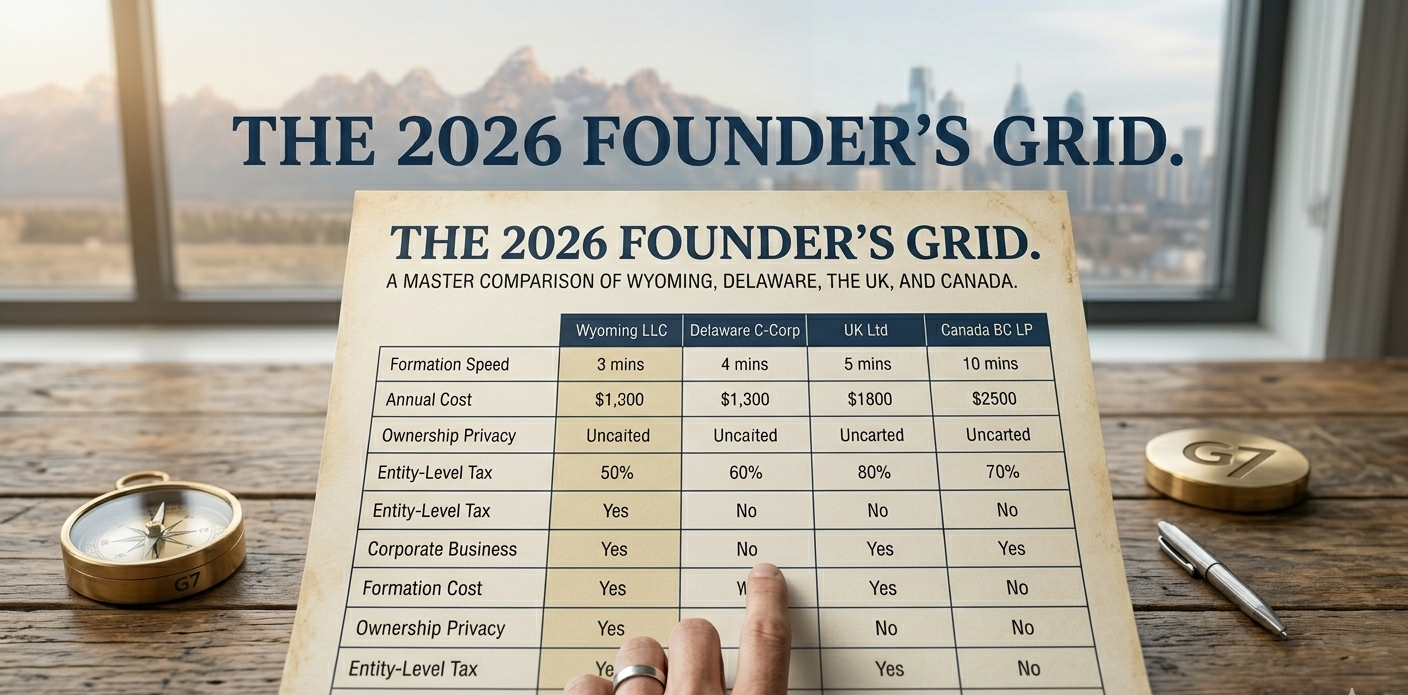
The 2026 Master Comparison Table
| Criteria | Wyoming LLC | Delaware C-Corp | UK Ltd | Canada BC LP |
| Formation Speed | 1–3 days | 1–2 days | Under 24 hrs | 3–7 days |
| Annual Cost | ~$185/yr | $400–$1,000+ | ~£40/yr | $500–$1,500 |
| Ownership Privacy | High (No Registry) | Low (Public Filings) | Low (Public) | Medium (Limited) |
| Investor Signaling | Low–Medium | Very High | Medium–High | Low |
| Entity-Level Tax | Pass-through | 21% Federal Corp | 19–25% Corp Tax | 0% for Non-Res |
| Banking Access | Moderate | Strong | Strong | Moderate–Strong |
| Non-Res Friendly | Yes | Moderate | Yes | Yes |
| Best-Fit Archetype | Privacy-first | VC-backed startup | Global-fast launch | Tax-efficient |
II. Jurisdiction Profiles
A. Wyoming LLC — The Privacy Play
Wyoming didn’t become a famous jurisdiction because of its geography or economy—it became famous because it made a deliberate policy choice to become the most founder- and owner-friendly LLC state in the US. In 2026, Wyoming remains the gold standard for entrepreneurs who prioritize a clean, low-cost structure without public exposure.
One-Line Identity: The best structure for founders who want a legitimate US presence without putting their name on a public registry.
Who this is actually for:
- Non-US Founders: Entrepreneurs who need a US entity for payment processing (Stripe/PayPal) or US customer credibility, but want to avoid triggering a US tax residency nightmare.
- Bootstrapped Operators: Solo founders or small teams running profitable businesses with no intention of raising institutional equity.
- Privacy-Conscious Founders: Operators in sensitive industries or high-conflict regions who do not want their ownership data indexed on Google.
Key Structural Advantages:
Wyoming is one of the few states that does not maintain a public registry of LLC members or managers. When someone searches the Secretary of State website, they only see your Registered Agent’s details. This “Privacy by Default” is reinforced by Wyoming’s lifetime proxy laws, which allow you to retain control while a proxy holds assets. Financially, Wyoming has no state income tax, no franchise tax, and no inventory or gross receipts tax. The annual report fee is a flat $185 for most entities, making it the most affordable “privacy haven” in the US. Furthermore, Wyoming’s asset protection laws are among the strongest in the nation; the “charging order” is the exclusive remedy for creditors, meaning they generally cannot seize your LLC’s assets to satisfy personal debts.
Key Friction Points:
While powerful, Wyoming LLCs are not “Investor Ready.” Most US Venture Capitalists will require a reincorporation into a Delaware C-Corp before writing a check, as the LLC tax structure is incompatible with their fund rules. Additionally, while the state level is private, the federal level is not. Under the 2026 FinCEN Corporate Transparency Act (CTA) requirements, you must still disclose beneficial owners to the federal government. Finally, some traditional international banks still exhibit slight friction when onboarding non-resident LLCs, necessitating the use of modern fintechs like Mercury or Wise.
The founder who should NOT use this: Anyone planning a venture-backed equity round in the next 18 months. The legal costs of converting an LLC to a C-Corp later can run $5,000–$15,000+. If VC is the plan, start in Delaware.
B. Delaware C-Corp — The Investor Play
Delaware is the default for a reason. Over 60% of Fortune 500 companies and the vast majority of VC-backed startups are incorporated here. This isn’t due to tax advantages for early-stage companies, but because of a massive legal infrastructure and investor expectation.
One-Line Identity: The only structure that lets you say “yes” immediately when an investor asks what entity type you are.
Who this is actually for:
- VC-Track Startups: Founders pursuing institutional venture capital, Y Combinator, or Tech-stars. Most US seed funds expect a Delaware C-Corp and will often make it a condition of investment.
- Equity-Heavy Teams: Startups planning to issue stock options to employees (ISOs) which require a corporate structure.
- Acquisition Targets: Founders building toward an IPO or acquisition by a major US company where the acquirer’s legal team will demand familiar Delaware mechanics.
Key Structural Advantages:
The Delaware Court of Chancery is a specialized business court with over 200 years of case law. Disputes are resolved by expert judges, not juries, providing a level of legal predictability that no other state can match. For founders, Delaware’s corporate statutes are incredibly flexible regarding board structures, dual-class shares, and protective provisions. The ecosystem is also fully integrated: tools like Carta and Pulley are built around Delaware defaults, and every startup lawyer in the US has standard-form Delaware documents ready to go.
Key Friction Points:
The price of prestige is high compliance. Delaware’s Franchise Tax is notorious; if calculated using the “authorized shares method,” an early-stage company can accidentally trigger a $50,000+ tax bill. Most founders must use the “assumed par value capital method” to bring this down to the $400 minimum, but the stress of the filing remains. Furthermore, a C-Corp is a separate tax-paying entity, leading to “double taxation” where profits are taxed at the corporate level (21%) and again when dividends are paid to shareholders. For non-residents, this also creates a “US tax nexus” that requires complex annual federal filings.
The founder who should NOT use this: A solo bootstrapper or a non-US founder with no plans for US investment. The compliance overhead and Franchise Tax are pure costs without a corresponding benefit if you don’t need investor signaling.
C. UK Limited Company — The Speed & Prestige Play
In 2026, the UK remains the most efficient G7 jurisdiction for incorporation. The process is entirely digital, visceral, and exceptionally fast—often taking less than 24 hours from submission to confirmation.
One-Line Identity: The fastest path to a credible, G7-jurisdiction business entity that the entire world will recognize.
Who this is actually for:
- Global Service Providers: Agencies, consultancies, and SaaS founders who need a legitimate entity to sign client contracts or onboard with payment gateways immediately.
- EMEA-Focused Founders: Entrepreneurs targeting European, Middle Eastern, or African markets where a UK “Ltd” carries significantly more institutional weight than a US LLC.
- Fintech-First Founders: Those who need guaranteed access to high-tier banking like Wise, Monzo, or Revolut, which have seamless onboarding for UK-registered entities.
Key Structural Advantages:
Companies House is a marvel of 2026 digital governance. Formation costs are low (£50–£100), and the annual “Confirmation Statement” is a simple online check-box that costs roughly £13–£50. The UK’s G7 status ensures that your “Limited” designation is legible to every bank and partner globally. Unlike the US, the UK has an incredibly dense network of over 130 tax treaties, which can drastically simplify withholding tax for international operations. Furthermore, the UK allows a single person to act as both the sole director and sole shareholder, making it highly attractive for solo operators.
Key Friction Points:
The major trade-off is zero privacy. Companies House is a public, searchable registry. Your name, month, and year of birth, nationality, and registered office address are searchable by anyone for free. In 2026, new rules under the Economic Crime and Corporate Transparency Act (ECCTA) have increased identity verification requirements for all directors. Additionally, UK Corporation Tax (currently 19–25%) applies to worldwide profits if the company is “centrally managed and controlled” from the UK. While there is marginal relief for smaller profits, it is still a real tax exposure compared to a pass-through LLC.
The founder who should NOT use this: Anyone for whom ownership privacy is a priority. The public record is permanent and indexed by search engines. If you need to stay off the radar, look to Wyoming or Canada.
D. Canada BC LP — The Trust & Tax Efficiency Play
The British Columbia Limited Partnership (BC LP) is the “hidden gem” of 2026 corporate structuring. Most founders haven’t heard of it because it requires slightly more explanation, but for the right profile, it is arguably the most structurally elegant option available.
One-Line Identity: A G7-jurisdiction entity that generates zero Canadian tax liability for non-resident partners earning non-Canadian income.
Who this is actually for:
- High-Revenue Non-Residents: Digital nomads or international founders earning revenue outside Canada who want a “white-listed” G7 entity with zero corporate tax drag.
- Prestige-Minded Operators: Founders who want to move away from “offshore” islands but still want a 0% tax environment.
- Asset Managers & Multi-Founder Teams: The General Partner/Limited Partner split allows for sophisticated management structures where one entity manages while others only provide capital.
Key Structural Advantages:
Under Canadian law, an LP is a pass-through entity. If the partners are non-residents and the income is generated outside Canada, there is no Canadian income tax at the partnership level. The profits “flow through” to the partners, who are only responsible for taxes in their own home country. This gives you the branding of a G7 country (Canada) with the tax profile of a traditional tax haven. Canada’s reputation is impeccable; unlike traditional havens, a Canadian entity rarely triggers the “red flags” that lead to bank account freezes or payment processor rejections.
Key Friction Points:
Complexity is the main hurdle. A BC LP requires at least two partners: a General Partner (who has unlimited liability and manages) and a Limited Partner. Most founders set up a separate corporation to act as the GP to protect themselves, which doubles the setup work. The “0% tax” claim also requires careful handling; as of 2026, global “substance” rules are tightening. You must ensure you aren’t accidentally creating a “Permanent Establishment” in Canada. Finally, the setup cost ($500–$1,500) is higher than the UK or Wyoming, as it usually requires a specialized service provider to handle the partnership agreement.
The founder who should NOT use this: Anyone who needs a simple, “one-sentence-explainable” business. The BC LP is powerful but requires a higher level of “corporate literacy” to manage and explain to third parties.
III. The Use-Case Matrix
The jurisdiction profiles provide the depth, but most founders have a dominant constraint that points clearly to one column.
| Founder Scenario | Recommended Structure | Deciding Factor |
| US-based, raising VC Seed | Delaware C-Corp | Investor expectation; SAFE compatibility |
| Non-US, wants US + Privacy | Wyoming LLC | Public registry avoidance; low cost |
| Global, Fast Launch needed | UK Ltd | Formation speed; G7 recognition |
| High-revenue non-resident | Canada BC LP | 0% Canadian tax on foreign income |
| Bootstrapped SaaS, solo | Wyoming or UK | Low maintenance; no equity overhead |
| Crypto project (DAO) | Wyoming LLC | DAO LLC statute |
| Europe-focused Agency | UK Ltd | Banking access; EU client credibility |
Avoiding the Three Decision Traps
Trap 1: Optimizing for the wrong future.
Many founders incorporate in Delaware because they assume they will raise VC—then spend years bootstrapping. They have bought expensive compliance for a future that never arrived. If VC is more than 18 months away, the “carry cost” of Delaware is a drain on your runway.
Trap 2: Ignoring banking as a first-order constraint.
The most tax-efficient structure is worthless if you can’t open a bank account. In 2026, KYC rules are tighter than ever. While the UK Ltd is the easiest to bank, the Wyoming LLC with a non-resident owner still faces significant scrutiny. If you need money flowing today, let banking access lead your decision.
Trap 3: Conflating jurisdiction with tax residency.
Where your company is incorporated is not the same as where you personally pay tax. A “0% tax” Canada LP still passes income to you. If you live in a high-tax country like Germany or France, your home country’s tax man will still want their cut of that income. The entity choice affects entity-level tax; your personal tax situation is a separate (and often more important) variable.
IV. What This Grid Doesn’t Cover
This section exists because a comparison tool that doesn’t name its own limits is a trap.
1. Personal Tax Residency
Every jurisdiction profile describes entity-level tax treatment. However, your personal tax bill is driven by where you are tax-resident. If you live in London and own a Wyoming LLC, you may still owe UK tax on those profits under “Controlled Foreign Company” (CFC) rules. The grid helps you choose a business vehicle; it does not replace a personal tax advisor.
2. Substance Requirements
In 2026, global “Anti-Base Erosion” (BEPS) rules are shifting. Simply having a “paper company” in Wyoming or Canada is becoming riskier. Tax authorities are increasingly looking for “Economic Substance”—meaning they want to see that real decisions are being made and real work is happening somewhere. If you are running a high-revenue operation, you must ensure your structure matches your operational reality.
3. Founder-Profile-Dependent Banking
Banking access is not just about the entity; it’s about you. Two founders with the same UK Ltd can have different onboarding experiences based on their nationality, the nature of their business (SaaS vs. Crypto), and their prior banking history. The grid gives a “directional signal,” but your personal profile will always be the final variable in the KYC process.
4. Multi-Entity “Stacks”
This guide assumes you are launching one primary company. It does not cover holding company structures, IP boxes, or inter-company royalty arrangements. If your business is at a stage where you are considering a Wyoming HoldCo for a UK OpCo, you have moved past the point where a single blog post should be your primary guide.
V. The “Snapshot” Reality
Tax laws and registry rules change. The 2026 Founder’s Grid reflects the landscape today—but Wyoming’s privacy laws or the UK’s corporate tax rates are subject to legislative whim. Revisit your structure every two years to ensure it still fits the current regulatory environment.
Final Verdict
The best incorporation decision is a fast one—made with the right frame, not the most information.
Most founders don’t fail because they chose the wrong jurisdiction; they fail because they spent six weeks in research paralysis instead of building. This grid exists to collapse that paralysis into a decision. Identify your dominant constraint. Match it to a column. Verify the friction points. Move.
Forward this to your co-founder, save the grid, or follow for deeper dives on each jurisdiction as a standalone series.
Frequently Asked Questions
1. Can I really own these companies without a local partner or residency?
Yes. All four jurisdictions allow 100% foreign ownership. You do not need a local director, a local shareholder, or a physical visa to own or operate these entities. In the case of a Canada BC LP, you simply need two “partners,” both of whom can be non-residents or foreign entities.
2. Do I need a physical office address in these countries to open a bank account?
While you don’t need to live there, banks and payment processors (like Stripe) now strictly require a Physical Business Address—and they often reject generic PO Boxes or well-known “virtual mailboxes.”
PLENTIS GROUP Note: We provide high-tier physical address solutions that satisfy the 2026 “Substance” requirements for banks. This ensures your account application isn’t flagged as “high risk” during the automated KYC checks.
3. Is a “Registered Agent” the same as a business office?
No. A Registered Agent is a legal requirement; they are a physical point of contact in the state to receive official legal documents (like a lawsuit or tax notice). They do not provide desk space or act as your warehouse. For banking, you will often need a separate “Mailing Address” to prove your operational presence.
4. Do I have to pay US taxes if my Wyoming LLC has no US customers?
Generally, if you are a non-resident and your business has no “Effective Connection” to the US (no employees, no warehouses, no offices in the US), you may have zero US federal income tax liability. However, you are still strictly required to file informational returns (like Form 5472). Failing to file these carries an immediate penalty of $25,000.
5. Why does the UK require “Identity Verification” in 2026?
Under the 2023 Economic Crime Act, Companies House now requires all directors to verify their identity using a passport or government ID. This was implemented to prevent “shell companies” and fraud. It’s a 5-minute digital process but is mandatory for your company to remain in “Good Standing.”
6. Can I open a bank account remotely for all 4 jurisdictions?
Yes, but difficulty varies. * UK and Wyoming: Very easy via fintechs like Wise, Mercury, or Relay.
- Delaware: Easy for fintechs; harder for traditional big banks without a physical visit.
- Canada BC LP: Requires the most documentation. You will likely need a professional introduction to a Canadian fintech or a global bank.
7. What happens if I forget to file my Annual Report?
In Wyoming, your LLC will be administratively dissolved after a short grace period. In the UK, you can face criminal fines and your company can be “struck off” the register. Always set a calendar reminder for your anniversary month; staying compliant is much cheaper than “reviving” a dead company.
8. Which structure is best for a “Secret” or Private business?
Wyoming wins. It is the only one in the Global 4 that does not list your name on a public, searchable state database. In the UK, anyone can see your name and month of birth for free. In Canada, ownership is semi-private but still more accessible than Wyoming’s “fortress” model.
9. Can I change my mind later (e.g., move from Wyoming to Delaware)?
Yes, through a process called Conversion or Domestication. However, it is a legal headache that involves new filings and tax considerations. If you know you want Venture Capital in the next 12 months, start in Delaware now to avoid paying $10k+ later to “fix” your structure.
10. How do I actually get the money from the company to my pocket?
Since these are mostly “Pass-Through” entities (except for the Delaware C-Corp), you simply transfer the profits from your business bank account to your personal bank account. This is typically recorded as an “Owner’s Draw” or a “Distribution.” You then report that income on your personal tax return in the country where you actually live.
